
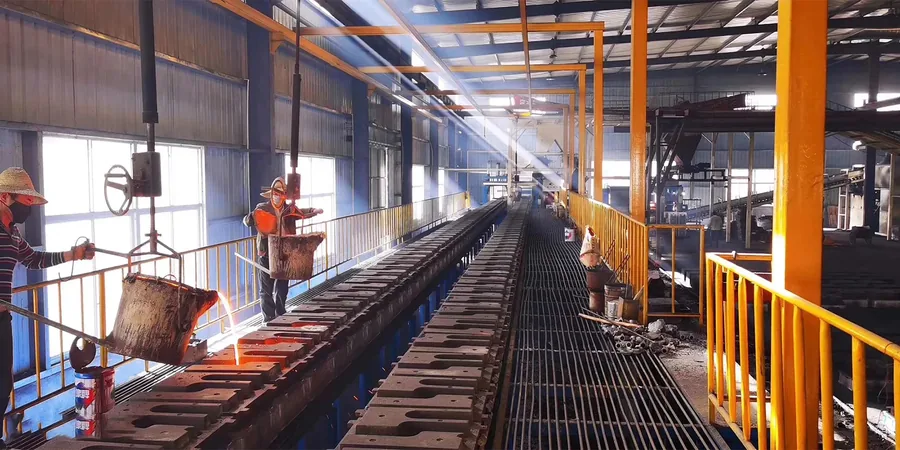
How to Choose the Right Casting Process
Four in-house casting routes cover the range from large wear castings to small precision components. The right route is matched to your part geometry, material, tolerances and order volume during review.
Compare Casting Processes
Indicative comparison — the actual selection is confirmed against your drawing and working conditions.
Green Sand Casting
The workhorse route for medium and large castings at competitive cost. Wide size and material range, fast tooling.
Shell Moulding
Resin-coated sand shells give better surface finish and dimensional consistency for repeatable series production.
Lost Foam Casting
Near-net-shape casting with complex geometry, generous draft freedom and reduced machining stock.
Investment Casting
Highest precision and surface finish in the family, suited to smaller components with tight tolerances.
| Process | Part size | Dimensional accuracy | Surface finish | Typical volume | Best suited for |
|---|---|---|---|---|---|
| Green Sand Casting | Small to very large | Standard | Standard | Medium to high | Large wear parts, structural castings |
| Shell Moulding | Small to medium | Better | Better | Series | Repeatable parts with consistent finish |
| Lost Foam Casting | Small to medium | Good | Good | Low to mid | Complex geometry, near-net shape |
| Investment Casting | Small | Highest | Highest | Low to mid | Precision components, fine detail |
Casting Process Selection FAQ
How do I choose a casting process for my part?
Can you combine processes in one project?
What decides tooling cost?
Do you support prototype to batch?
Still Deciding? Send What You Already Have
A part number, equipment model, drawing or sample photo is enough to start the review. We propose the material families and process routes that fit your application.